It’s 1:55am, and I’m supposed to be at work in five hours. Via a friend, who can provide a ride, I landed a $15/hr part-time gig. It’s a super-laid back assembly job, and I only need to leave my chair a half-dozen times the whole day. It’s exactly what I need to heal my leg, maintain my mental sanity, and bolster my hiking budget. The Trail provides.
A little over two weeks from my Harper’s Ferry leave date, I can’t help but feel that they’re paying me in Tarptent Aeons…
Because I’ve been bored out of my damned mind, I’ve been binge watching Vikings on Amazon Prime. I like the series so far, and all of the rampant axe use has stirred up a latent interest of mine in Bushcraft and wilderness living skills. Ultralight backpackers and Bushcrafters are often thought to be at opposite ends of the back country spectrum (or so r/ultralight tells me) but I have found value in both.
The primitive skills coveted in Bushcraft and minimalist efficiency of ultralight backpacking are far from oppositional. In reality, they push each other back towards each other’s core ethos. What I’ve observed is Bushcrafters carrying way too much shit and ultra-lighters lacking basic survival knowledge.
We’ve all seen that overweight camo-pack guy trudging up the hill, loaded out for the weekend… Or the Yukon… Similarly I’ve seen the Zpacks kids shivering in the wind, with blown hipbelt seams, who tell me they cannot sew. Wisdom lies somewhere in the middle. I have been both of these to some degree, but I certainly tend towards UL these days.
I’ve been brushing up on my Bushcraft skills over at BushCraftUSA.com, via their Bush Class sub-forum. These lessons start with the basics like how to sharpen a knife, and how to make a basic camp fire. They elevate to bowdrill and hand drill fire making, primitive shelters, etc.
I’ve taken several classes with Mark Warren, a naturalist and wilderness living teacher based out of Dahlonega, GA. After spending four hours constructing a lean-to (with four people) in one of his classes, and spending an entire day trying to make fire from sourced natural materials, I had a perspective shift. It made me value my light weight backpacking gear in a way I never had before. I carry a small tarp on EVERY outing as a result of that class. Where I used to see extra ounces, I now see four hours of freed up time I might need if a real situation should arise.
Additionally, as a result of his Plants of Autumn class, I truly do feel more at home in the woods. In learning the plants I now have friends who live in the forest. They are able to feed me, warm me, and keep the bugs off of me. They can shelter me, break my fever, or even soothe my stomach. They’re great friends to have!
On the ultralight end, I do not fear pack any more. I do not take backups and multiples, because I do not need them. I ruthlessly trim excess and push my limits by going without. This allows me to travel light and fast.
So I think both aspects, Bushcraft and UL have so much to offer. Both should be thoroughly explored. If you’re stuck inside for a while, check out reddit.com/r/ultralight or BushCraftUSA.com
Here’s one for the gram weenies and gear nerds. I’ve decided to swap out a few of my venerable backpacking items with newer, better alternatives.
Headlamp
Nitecore NU25 on top, Fenix HL50 (band removed) on bottom.
I’ve been using the Fenix HL50 for the better part of six years now. It’s IPX8 waterproof, and can be configured to run both AA and CR123 Lithium batteries. It’s durable and utterly reliable, but it has two shortcomings.
The first is that the switch is too sensitive. Even in my hipbelt pocket, I’ve had it turn on accidentally. Because of this I unscrew the battery cap just enough for the battery to lose contact. It’s an annoying task to add to my morning packing routine, but a necessary one, as there are no other lockout options.
Another annoyance, particularly in AT shelters and other crowded camp areas, is that there is no red light feature. More than one hiker has grumbled at me to turn on my red light, so I’ve decided to buy a light that actually has one.
This is the Nitecore NU25. I’ve been using its bigger brother, the HC65 at work for months. Nitecore has impressed me with their quality and reliability, so I’ve decided to give the NU25 a shot.
Not only does it have an auxiliary red light, it also has a simple lockout feature. Additionally, it’s USB rechargeable, and it has a battery level indicator. The run times are very similar to the Fenix HL50, although the NU25 is a bit more delicate and less waterproof. It’s a full two ounces lighter though, coming in at 1.2oz with my DIY headband.
Shout out to Backcountry Banter for his great review and instructional on the NU25!
Auxiliary Water Storage
Secondary water storage on the AT is a luxury item. There’s water everywhere, but when I roll into camp I only want to make one trip to the spring. I typically filter two liters to cook and have overnight, then an additional two liters to roll out with in the morning.
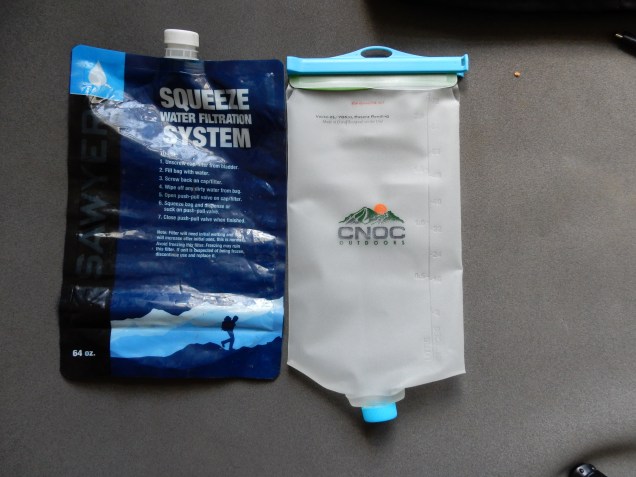
I’ve been using these 2-liter Sawyer bags for a while. At 1.6 ounces they’re light and fold flat when not in use. The problem is that they’re not at all durable. Sometimes failing in as little as 150 miles of use.
These CNOC bags are more expensive, and they’re heavier at 2.7 ounces. When I met a section hiker who stood on his to prove the durability me, I was sold! They also feature a slide lock on one end, which aids easy filling. This solves another issue with the Sawyer bags, which are difficult to fill from pools and slow moving water sources.
Water Purification
The AT has changed a bit, particularly the availability of some products, as others have gained popularity. It is because of this that I had a more and more difficult time finding Aquamira on the trail.
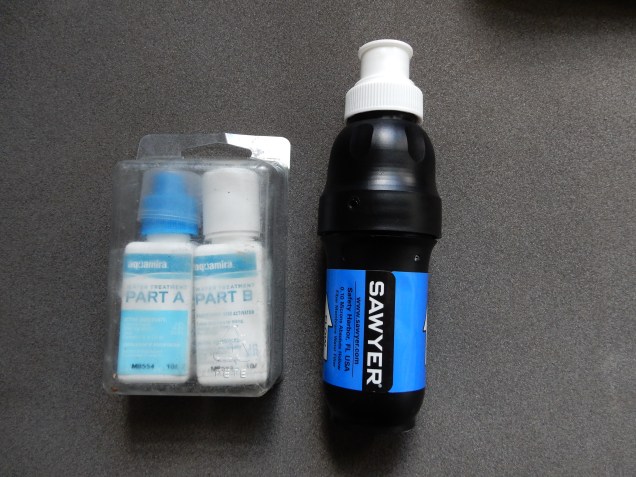
Aquamira has been my water purification of choice for many years, because it’s light, compact, and impervious to cold weather. The two downsides are that it takes time to work, and it’s a consumable. The filter time is much faster than similar products, a total of twenty minutes from stream to mouth. The bottles are opaque though, and it’s difficult to accurately gauge how much you have left. More than once I’ve run out in the middle of a weekend trip, or on my first day out from town. No biggie. I always keep backup tablets, three days worth, in my first aid kit.
With limited on-trail availability, and at $15 a pop, I’ve decided to go back to the Sawyer Squeeze filter.
The Sawyer Squeeze has two points of failure. As noted above, the squeeze bags are garbage. Secondly, If you freeze the filter itself, it becomes garbage too. This is very easy to do in the mountains, with temperatures dropping below freezing in places like the Smokies, even in mid-May.
That said, with the new CNOC bag, I’m pretty confident this will be my new go-to system. In the summer months especially, having instantly drinkable water is really nice. Additionally, these filters will thread onto just about any water bottle if needed.
At $30 for one filter, it pays for itself overtime. As for weight, the full sized Sawyer is 2.9 ounces. Full Aquamira bottles are exactly the same weight.
Cables & Cords
Micro USB cable compared to an adapter instead.
Weight creeps in where you least expect it, and charger cables are no exception. I have saved no less than 1.5oz by switching from a 6ft USB C cable, to a 1ft version. Additionally, instead of carrying a full cord to charge my MP3 player, I’ve found this adapter instead. While the weight savings is only .3oz, it’s 50% reduction in weight for this item.
Often when going lighter, looking at percentages is more valuable than weight itself. A 50% weight decrease is a big deal. If you can do that across your whole kit, think of the implications!
Other Ideas
Conventional pot/ stove/fuel VS. Cold-soaking container
Before hoping back on trail, I am considering two other major gear tweaks. The first would be to go stoveless, and cold-soaking my food instead. This shaves 3 oz out of my cook system right off the bat, and it can save an additional 3-12oz in fuel.
Much like Aquamira, fuel for alcohol stoves is becoming less and less available on the trail. My assumption is that most of us alcohol stove users have gone to cold-soaking, and I’m just late to the game. It would be nice to never have to worry about sourcing fuel again. Cold-soaking is also very efficient from a time perspective. You simply pour your dinner into an empty ice cream or peanut butter jar, pour in some water, and seal it up. Roughly 30min later, you have edible pasta/mashed potatoes/oats, etc.
While I do love hot food during the winter, I really don’t mind cold food in the summer. Instant coffee just goes straight into my water bottle these days.
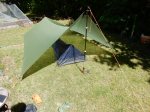
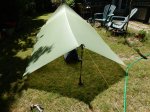
The second big change I can make is swapping my tent for a tarp and bivy. The tent pitches faster, and is more weather proof, but the tarp is roomier and less prone to condensation. An added benefit is that the bivy can be used in a shelter, adding comfort on buggy nights.
My much loved Tarp Tent Protrail
I’ve used tarps extensively, with and without a bivy, for years. I’ve been hesitant to use one on a thru-hike, and I really don’t know why. I suppose it’s the “home” factor, the privacy, or just the simplicity of pitching the tent in a single unit. Regardless, the 12oz+ in weight savings is pretty alluring!
Thanks to my dear friends, Bowman and Sherre, I’ve been able to attend some Dharma talks lately. They’ve both become extremely important mentors to me, the kind of people who know you need help before you even ask for it. It’s difficult to express the gratitude I feel for their unfailing kindness.
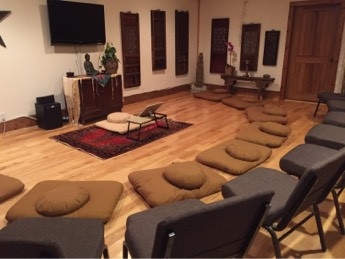
I’ve sat with three Sangha’s for the past few years. One was instrumental in teaching me basic meditation. The second, taught by the same teacher, lead me down the path of sobriety I have walked for nearly two years now. Sadly that Sangha has dissolved. The third has become my real home, and we meet at the beautiful Heron House in Roswell every Monday.
Meditation hall at the Heron House
My daily meditation habit has been anything but daily for nearly a year now. It’s amazing how fast that happened! About a year ago, I allowed another person to enter my practice. I allowed them to sit with me at 5am on the dot, as I had for many many months previous. It wasn’t a problem until I fell in love with her. At that point waking her for meditation evolved a new temptation; crawling in and cuddling with her instead 🙂
I have no regrets for those happy moments, but I realize now that in taking them, I began to forfeit the relationship as a whole. It was the first of my boundaries to be set aside, the first of several more to come.
I’ve been sitting much more lately. I even had the opportunity to do a one day silent retreat with Lucinda Green last weekend. She’s a wonderful teacher, and restored the integrity of my metta practice by having us do metta exercises with a partner. We took turns sending loving kindness intentions towards each other, and I felt that energy palpably in my heart-space. I haven’t felt that sensation in a very long time.
As an experiment, Lucinda asked us to then throw up a wall, and refuse to receive the energy from our partner. As my partner put up that wall I felt sick to my stomach. It was instant! I had the same sensation when I put up my own wall. Nearly everyone reported this. We didn’t end like that thankfully. Instead we re-balanced our energy equally between us, and parted slowly back into ourselves.
I felt that my metta was restored, because I could feel the intentions flowing outward from my heart-space again. Lately I would repeat the words of intention in my mind during metta practice, but I wasn’t feeling them flow out from my heart anymore. They were empty. It reminded me of Christ’s words:
“And when you pray, do not keep on babbling like pagans, for they think they will be heard because of their many words.”
The last time I had heart-felt metta like that, I was sending it to Molly. We were meditating in a candle-lit room together, and I was trying with everything I had to heal an emotional wound that festered between us.
During the retreat I realized that I’ve done all of the work I’ve needed to around that relationship. I’ve seen it clearly, and I can reflect on her with love now. I’ve let it go.
Five months isn’t bad. The last break up took 1700 miles and nearly three years of celibacy to processes. I had a lot of growing to do though, and I needed that space.
This last one taught me about boundaries. I’ll never let anyone treat me the way she did again. Hopefully I’ll never be that needy again either.
Mark Manson wrote a wonderful book on relationships called Models. This title has become far lessor known after the success of his other book, The Subtle Art of Not Giving a Fuck. Both are great, but Models is particularly helpful. I’ve had this pattern of “getting the girl” and then becoming impossibly needy until I drive her away. Passive always becomes aggressive in time. Assertive is the magic middle ground of healthy relationships.
I’m the kind of person who feels bad for taking up space in a grocery line. Assertiveness doesn’t come naturally to me. This is probably why I feel most comfortable in the middle of nowhere by myself.
At least three times Molly and I went out to dinner, only for me to stare off into space the whole time. This was a function of me agreeing to go out, when what I really wanted and needed was time alone to think. I’ve also become aware that if another person requires your effort to hold their boundaries, they’re not in a place to be assertive either. It’s unwise to date such a person, or date if you are that person.
Of course these ideas extend outside of romantic relationships as well. All of my friendships have improved, the more assertive I’ve become. There are some people who’s phone calls I ignore a lot. Sometimes for days. I do this so that I can call them back when I am in the best space to speak with them; when I’ll give them my best self. It seems counter-intuitive, but I’ve never once had to explain myself. As Elbert Hubbard pointed out, good friends don’t generally require much explanation anyway.
What does this have to do with the AT you might ask? Who knows? Relationships are pretty critical out there, why not seek to be better at them?
One of the side-affects of being home and necessarily still, is that a lot of the emotional processing I had hoped to do on trail, is happening now instead. I had been kicking a proverbial shit-can of feelings down the road for months in anticipation of this hike. Despite my best efforts to keep it rolling during this hiatus I’ve failed, and it’s leaking shit everywhere.
A big motivator for my hike this year was making sense of my last relationship. Not putting the pieces together mentally, so much as channeling the residual sadness, and anger somewhere. There’s a lot of pain still there, and I had hoped to callus an open wound with miles.
For this reason, I doubt I’ll be writing much until June. I’ll be taking a bus to DC, and from there to Harper’s Ferry, WV on the 5th. My Northbound hike has officially become a Flip-Flop hike.
To hike a Flip-Flop, you start somewhere in the middle of the trail. Traditionally, it is started at the ATC headquarters in Harper’s Ferry. The first leg involves a 1167 mile hike to Mount Katahdin in Maine, then a bus ride back to Harpers Ferry. From there, the next leg is 1025 miles south to Springer Mountain in Georgia.
The Appalachian Trail Conservancy tries to encourage this route, as it minimizes crowding and overall impact on the trail itself. Much the opposite of my 2016 hike, where I was utterly desperate for company, I found myself wanting much more solitude this year. Two-thirds of the North Bounders have typically quit by Harper’s Ferry, so the trail north of there is pretty quiet. In fact, the contrast was so stark, loneliness nearly sent me home in PA twice during 2016.
The trail is surprisingly flat north of West Virginia into Maryland. This continues through Southern PA, which is mostly farm fields. From an injury/recovery standpoint, it’s an ideal place to return. The Northern half of PA is virtually all highly technical rocky hiking. It’s total bullshit actually, but it’ll keep my daily mileage low by default. When you ascend into New Jersey the trail becomes dumbfoudingly beautiful again.
Then there’s the 500 miles on the northern quarter of the trail I’ve never seen before. I can’t wait!
Until then, I’m going to keep mashing my keyboard with word-processor-therapy till the wee hours of the morning. In true INFP fashion, I can write a doctoral dissertation after every breakup. I’d rather be hiking!





 Dirty Girl Hikes